
The line at Heathrow Terminal 5 security was moving fast until the officer pulled a large black power bank from a traveler's bag and set it on the tray. The device was a 30,000mAh unit the traveler had been using for eighteen months across a dozen countries without a single problem. This time, a supervisor appeared, ran the numbers on a laminated reference card, and that was it: the bank went into a confiscation bin. The traveler watched it disappear along with the £89 they'd paid for it. This scenario plays out thousands of times a week at airports around the world, and almost every time the traveler is completely blindsided. They bought a battery. It charged things. Nobody stopped them before. The problem is that enforcement is inconsistent until it isn't: regional airports in Southeast Asia may wave through oversized power banks for months, then suddenly crack down. A passenger on an Emirates flight out of Dubai gets a pass; someone on the same itinerary six weeks later does not. The rules governing lithium batteries on aircraft are not vague. They are published, specific, and grounded in real fire-risk data from incidents like the 2016 Samsung Galaxy Note 7 recalls. What is vague is how and when individual airports and carriers enforce them. Your job as a remote worker who flies regularly is to know the numbers cold so that your gear never ends up in a confiscation bin regardless of which supervisor is on duty that day.
Affiliate Disclosure: This article may contain affiliate links. If you purchase through these links, we may earn a commission at no additional cost to you.
Quick Pick: Which One Is Right For You?
Based on your needs
Anker 737 Power Bank
€74,99
The ultimate power bank for laptop users who need serious portable charging power.
Check PriceBaseus Blade 100W Slim External Battery
€59,99
Perfect slim power bank for travelers who want laptop charging without bulk.
Check PricePrices may vary. As an Amazon Associate, we earn from qualifying purchases.
The Challenge
The core number you need to know is 100 watt-hours. Under FAA regulations (49 CFR 175.10) and the IATA Dangerous Goods Regulations 2026 edition, spare lithium-ion batteries at or below 100Wh may be carried in carry-on baggage without any special approval. Above 100Wh and up to 160Wh, you can carry a maximum of two spare batteries in carry-on only, but you need explicit airline approval before boarding. Above 160Wh, the battery is banned from passenger aircraft entirely. No exceptions. The confusion for most travelers starts with mAh. Nearly every consumer power bank on the market lists capacity in milliamp-hours, not watt-hours. A 20,000mAh bank at 3.7V nominal voltage works out to 74Wh: fine, no questions asked. A 27,000mAh bank at the same voltage is 99.9Wh: technically compliant but close enough to the limit that some officers will scrutinize it hard. A 30,000mAh bank is 111Wh: over the threshold, requires airline approval, and if you show up without it the bank gets confiscated. Enforcement inconsistency adds another layer of difficulty. Narita and Frankfurt apply these rules with precision. Some smaller regional airports barely check. This creates a false sense of security: you fly through ten airports without a problem and conclude your 28,000mAh bank is fine. Then you hit Heathrow T5 on a day when the security supervisor has just completed a DG refresher course.
The Solution
The fix is straightforward once you internalize three things: the math, the placement rule, and the approval process. The math: Wh = mAh × V ÷ 1000. Most lithium-ion cells run at a nominal 3.6V or 3.7V. A 20,000mAh bank at 3.7V = 74Wh. A 26,800mAh bank at 3.7V = 99.16Wh. A 27,000mAh bank at 3.7V = 99.9Wh. These all clear the 100Wh threshold. A 30,000mAh bank at 3.7V = 111Wh. That requires airline approval for carry-on and cannot go in checked baggage under any circumstances. The placement rule is absolute: spare lithium batteries (meaning batteries not installed in a device) must travel in carry-on baggage. Not in your checked suitcase. Not in your stowed duffel. Carry-on only. Batteries installed in devices (your laptop, your phone, your camera) may travel in either carry-on or checked baggage, but the device should ideally be in carry-on where you can monitor it. The approval process for 100-160Wh batteries means contacting the airline before you travel, not at the gate. Emirates, Qatar Airways, Japan Airlines, and most full-service carriers have a dangerous goods contact process on their websites. Low-cost carriers like Ryanair and easyJet are more restrictive: both cap spare batteries at 100Wh without exception on most routes, and gate staff are not authorized to grant approvals. Check the specific carrier policy every time, not just once.
Key Battery Regulations You Need to Know
The 100Wh Universal Rule
Every major regulatory body, including the FAA (via 49 CFR 175.10), EASA, and IATA DGR 2026, agrees on 100Wh as the threshold for unrestricted spare lithium battery carry-on. At or below 100Wh, no approval is needed and no quantity limit applies beyond what the airline considers reasonable (typically 2-3 spares). This covers the vast majority of consumer power banks on the market. A 26,800mAh bank at 3.7V comes in at approximately 99.2Wh and clears this threshold. A 20,000mAh bank is around 74Wh. The 100Wh limit is the number to design your kit around if you want zero friction at security.
100-160Wh with Airline Approval
Batteries between 100Wh and 160Wh can fly in carry-on as spare batteries, but only with prior airline approval and a maximum of two batteries per passenger. This range covers larger power banks (27,000-43,000mAh range) and some professional-grade laptop batteries. The approval process varies by carrier: full-service airlines like Emirates, Qatar Airways, and Japan Airlines have explicit dangerous goods approval forms or email processes. Low-cost carriers including Ryanair and easyJet typically do not grant these approvals for passenger carry-on, making them effectively banned on those routes. Always confirm directly with the airline at least 48 hours before departure.
mAh to Wh Conversion Math
The formula is: Wh = (mAh × V) ÷ 1000. The voltage to use is the battery's nominal voltage, typically 3.6V or 3.7V for lithium-ion cells. Most manufacturers list this on the battery label or in the product specifications. If only mAh is listed, assume 3.7V for a conservative estimate. Examples: 10,000mAh × 3.7V ÷ 1000 = 37Wh. 20,000mAh × 3.7V ÷ 1000 = 74Wh. 27,000mAh × 3.7V ÷ 1000 = 99.9Wh. 30,000mAh × 3.7V ÷ 1000 = 111Wh. If the battery already displays a Wh rating on the label, that number takes precedence over any calculation.
Carry-On vs Checked Baggage Rules
Spare lithium batteries (batteries not installed in a device) are prohibited in checked baggage under IATA DGR rules, period. They must be in carry-on baggage, protected against short circuit (keep them in their original packaging or a battery case), and terminals covered. Batteries installed inside a device may travel in either carry-on or checked baggage, but the device must be fully powered off and protected from accidental activation. Practically: your laptop, phone, and camera body can go in checked luggage if needed. Your spare power bank cannot. If you pack a spare battery in your checked bag and it is discovered during screening, it will be removed and may be confiscated.
Per-Battery Count Limits
The IATA limit for batteries in the 100-160Wh range is two spare batteries maximum per passenger, with airline approval. For batteries under 100Wh, there is no hard IATA count limit, though airlines can apply their own reasonable restrictions. In practice, showing up with six power banks raises flags regardless of their individual watt-hour rating, because screening officers are looking for total energy quantity as well as per-unit compliance. A reasonable travel kit is one 100Wh power bank for daily use, plus one spare under 100Wh for backup. If you need more capacity than that, consider a single higher-capacity approved bank rather than multiple smaller ones.
Airline-Specific Variations
FAA and IATA set the floor, but individual airlines can impose stricter limits. Ryanair and easyJet both state on their dangerous goods pages that spare lithium batteries must be under 100Wh, effectively eliminating the 100-160Wh approval pathway for most leisure routes. Japan Airlines (JAL) and ANA follow IATA closely and do have an approval process for 100-160Wh batteries, but it requires advance written notice. Emirates and Qatar Airways also follow IATA with approval available, but gate staff cannot authorize it: the approval must come from the airline's dangerous goods team before you check in. Always check the specific carrier policy on their dangerous goods or lithium battery page, not a third-party summary.
Spare vs Installed Battery Distinction
The regulatory distinction between a spare battery and an installed battery matters more than most travelers realize. An installed battery is one that is inside a device and powering it or stored in its normal position within the device. A spare battery is any lithium battery being transported separately, including a power bank that is not connected to anything. This means a 74Wh power bank sitting loose in your bag is a spare battery subject to carry-on-only rules. That same power bank plugged into your laptop via a cable while in your bag is still technically a spare battery under most interpretations, because it is not installed inside the laptop. Keep power banks in carry-on and terminals protected regardless of whether they are connected to something.
Research Methodology
The regulatory information in this article is drawn directly from primary sources: FAA PHMSA 49 CFR 175.10 (current edition), the IATA Dangerous Goods Regulations 2026 (67th edition), and the dangerous goods or lithium battery policy pages of the named carriers as accessed in early 2026. Where carrier policies differ from IATA baseline rules, those differences are noted based on the carrier's own published documentation rather than third-party interpretation. Real-world enforcement notes are based on documented traveler reports and airport dangerous goods incident data. This article does not reflect legal advice: regulations change and individual screening decisions involve officer discretion. Always verify current limits directly with your carrier and the relevant national aviation authority before traveling with batteries above 100Wh.
Our Recommendations

Anker 737 Power Bank
€74,99
Price accurate at time of writing. Check latest price on Amazon.
This is the power bank that finally replaces carrying a laptop charger. The 140W output means MacBooks charge at full speed.
Best for: The ultimate power bank for laptop users who need serious portable charging power.
What We Like
- 140W output charges laptops fast
- Smart digital display
- Compact for capacity
- Premium build quality
Considerations
- Heavy for pocket carry
- Premium price
Key Specifications
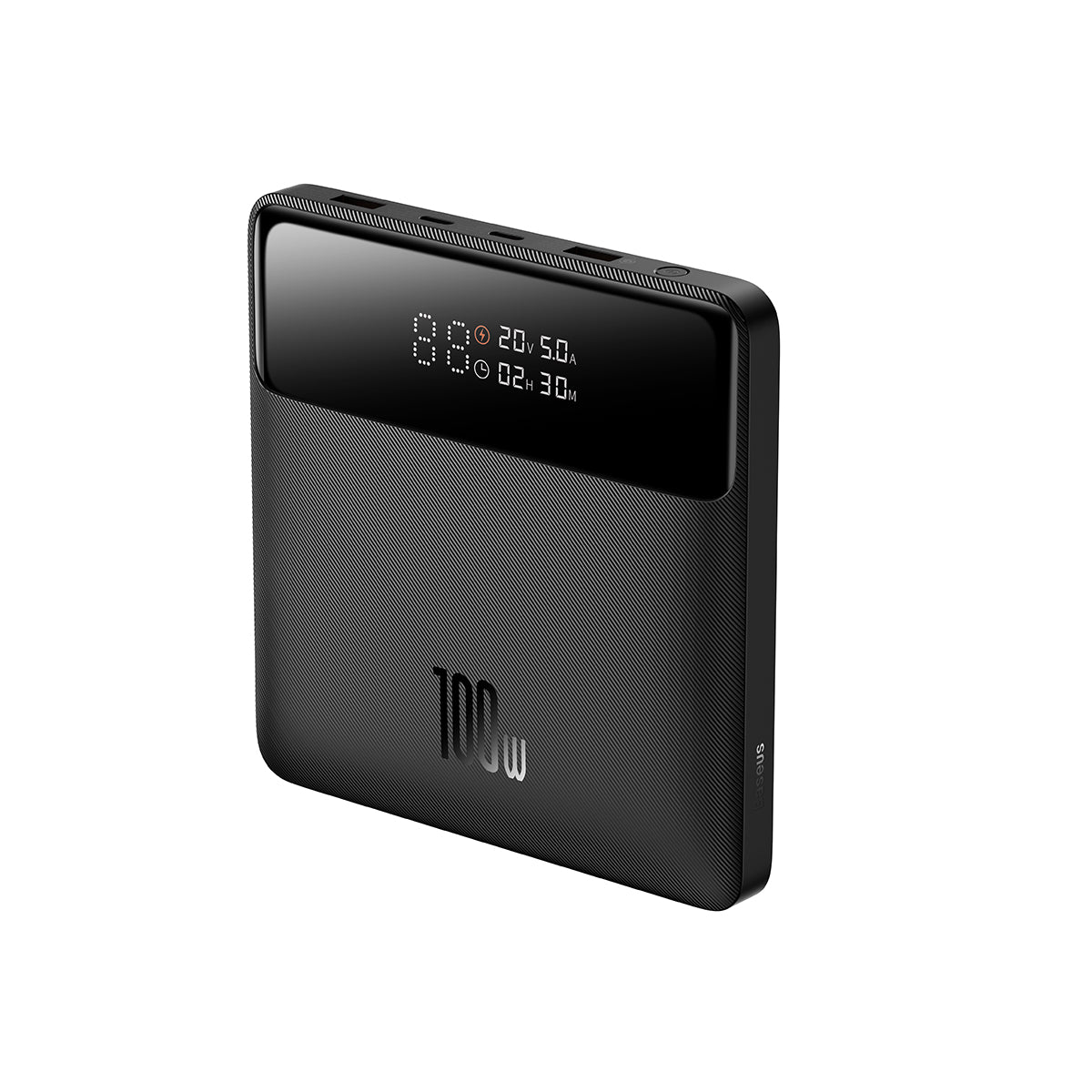
Baseus Blade 100W Slim External Battery
€59,99
Price accurate at time of writing. Check latest price on Amazon.
The Blade 100W proves you don't need a brick to charge your laptop. Slips into any bag pocket.
Best for: Perfect slim power bank for travelers who want laptop charging without bulk.
What We Like
- Ultra-slim profile
- 100W two-way charging
- Airline safe capacity
- Great value
Considerations
- Lower capacity than competitors
- Gets warm during fast charging
Key Specifications
Quick Comparison
Prices accurate at time of writing. Check Amazon for current pricing.
| Product | Rating | Price | Best For | Action |
|---|---|---|---|---|
Anker 737 Power Bank Best Overall | 4.8 | €74,99 | The ultimate power bank for laptop users who need serious portable charging powe... | Check Price |
Baseus Blade 100W Slim External Battery Best Budget | 4.6 | €59,99 | Perfect slim power bank for travelers who want laptop charging without bulk.... | Check Price |
Choosing Airline-Compliant Power Banks
The 100Wh mark is the single most useful number for building a travel power kit. Batteries at or below 100Wh clear every airline's threshold without any approval process, fly on Ryanair and easyJet without argument, and comply with both FAA and IATA rules as carried spare batteries. The sweet spot products in this category cluster around 26,800mAh (approximately 99Wh at 3.7V) and are widely available from Anker, Baseus, and Ugreen. The Anker 737 Power Bank (24,000mAh, 87Wh) is a 140W unit that fast-charges modern laptops and is clearly labeled with its Wh rating. The Baseus Blade HD (20,000mAh, 74Wh) is slimmer and laptop-compatible at 100W output. Both clear 100Wh comfortably and will not create problems at any airport. If you actually need more capacity, a 130Wh bank in the 100-160Wh approval category is viable on full-service carriers, but adds pre-travel paperwork. Factor in the time cost of the approval process: contacting Emirates or JAL dangerous goods teams 48+ hours before every flight, saving confirmation emails, and presenting documentation at check-in. For most nomads, two 74Wh banks (total 148Wh combined capacity, each individually compliant under 100Wh) is a better system than one 130Wh bank requiring approval. For anything above 160Wh, including portable power stations like the Jackery Explorer 300 or EcoFlow River 2, the answer is clear: these cannot fly as carry-on or checked baggage on passenger aircraft. If you need a power station at your destination, either ship it via cargo freight, rent one locally, or buy one on arrival in countries where they are readily available and inexpensive. When buying, verify that the product listing shows a Wh rating, not just mAh. A power bank sold as "20,000mAh" is likely 74Wh, but without a label confirmation you will face questions at security. Any power bank worth buying from a reputable manufacturer will show the Wh value on the label: if it does not, that is a quality signal worth paying attention to. For e-bikes, CPAP machines, and specialty medical devices, the rules have specific carve-outs: see the FAQs below.
Related Reading
Common Questions
Review Transparency
Our reviews are based on real-world remote work needs including portability, power autonomy and connectivity reliability while traveling.
Affiliate Disclosure: This article may contain affiliate links. If you purchase through these links, we may earn a commission at no additional cost to you.
Related Remote Work Tools
More Guides You'll Love

Explore More Categories
Get Personalized Gear Recommendations
Stop guessing which gear to buy. Fill out our quick questionnaire and receive a custom PDF with the exact products for your setup, budget, and travel style.